An act of bravery – Richard Harold Wakeley (1900-1959)
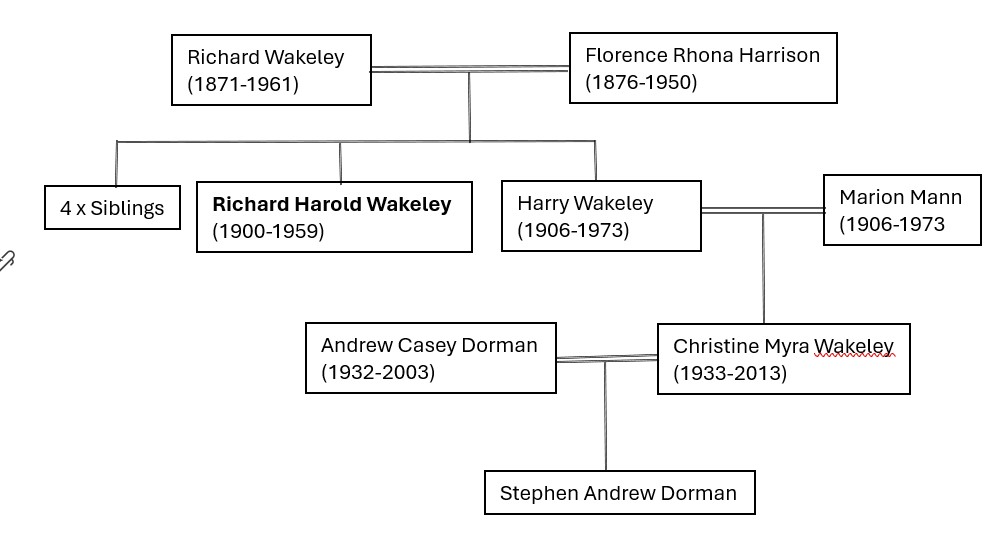
In the midst of war on the home front in January 1941, a train was pulling into Pear Tree station, Derby, when a woman fell from the platform in front of the incoming locomotive. A passenger guard working for the London Midland Scottish railway company reacted by leaping onto the tracks and pulling the woman to safety. The woman was largely unharmed while the guard was struck a glancing blow by the train. That guard who acted without concern for his own safety was Richard Harold Wakeley (1900-1959), a great-uncle.
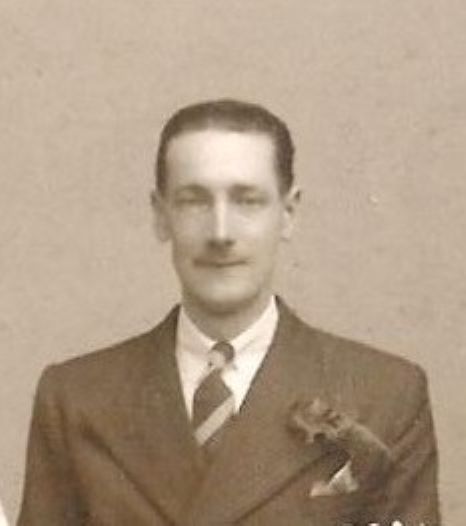
I do not recall ever hearing of this event within the family and only came across it while running a general newspaper archive search. It is possible that, given the period in which it occurred, the significance was simply overwhelmed by all the other momentous events happening over those years.
On 20th January 1941, Richard Wakeley, who had arrived at Pear Tree & Normanton station on a train from Crewe, was waiting for a return train. In the dark of evening and with snow falling, the female passenger left the lighted waiting room to catch her train. She failed to see the edge of the platform and fell onto the line. At that time a non-stopping train was approaching the station and was about 100 yards away. Seeing what had happened Richard Wakeley jumped onto the line and with the train now about 15 yards away, picked up the female passenger and threw her into the empty line opposite. While then jumping clear himself he was struck by the engine wheels, with the train travelling at about 25mph, sustaining a bruised temple and a severe cut on the right thigh.
These injuries lead to him being detained in the Derbyshire Royal Infirmary for 6 days, although he was incapacitated for about 7 weeks. While detained in the hospital, Richard Wakeley was visited and thanked for his ‘gallant action’ by the woman he saved. He admitted in an interview that “he had had a close shave and that there was no time to consider what he should do, with every possibility that had he not acted promptly, there was every possibility that the young lady would have been killed”.
In the summer of 1941 Richard Wakeley’s courageous act was recognised by the L.M.S. Railway Company with the award of the Stamp Medal [Note 1] and a monetary award of five guineas. The Stamp Medal was presented by the Chairman of the LMS at a board meeting, along with those to two other members of the company being recognised for meritorious acts. The presentation (including a photograph) featured in the June 1941 edition of ‘Carry On’, the LMS Staff Journal.
An award was also made of a certificate of the Carnegie Hero Trust Fund (www.carnegieherofundtrust.org) and a cheque for £15 [Note 2]. The presentation was made on behalf of the Carnegie Fund at Crewe Station by the Vicar of St. Peter’s Church, Crewe, and by the Stationmaster.
Note 1: The Stamp Medal was instituted in early 1940 and named after the president of the London Midland Scottish railway company. It was introduced for all grades of L.M.S. staff to commemorate acts of courage or to mark meritorious service by special devotion to the interests of colleagues, special initiative, etc.
Note 2: Unfortunately, there is an error in the citation & roll of honour entry – they state that the event took place at Crewe station, but it actually occurred at Peartree & Normanton station in Derby. It appears that this mistake stems from the report submitted to the Carnegie Fund by a senior railway company manager who named the correct station but noted it as being in Crewe rather than Derby. Richard Wakeley lived and was based in Crewe. The Derby location is confirmed in the remainder of the manager’s report, in Richard Wakeley’s own account and in local newspaper reporting.
 Dorman & Wakeley Family History
Leave a comment