This is a broad summary of occupations through the years looking across the whole breadth of the family tree not solely concentrating on the direct-line portion. The list of occupations is based on a range of records e.g.
- Official registrations (births, marriages, deaths).
- Church records (baptism, marriage).
- Census.
In most instances the record provides no real detail on the occupation but gives a fairly generic label (e.g., labourer, railway worker, agricultural labourer). Also, a single type of occupation may be referred to using different labels. But it is possible to provide a general picture of the breadth of occupations undertaken by our forebears.
Across the records available there are more than 300 job titles used with the great majority appearing just once or twice. So, for this summary, the individual job titles were allocated to broader job categories (e.g., domestic service (groom, kitchen maid, housemaid etc.); transport (mainly various railway employments); industrial (iron workers, miners etc.); miscellaneous (not falling into another particular category); etc.). [See tables below for the main job titles within the six main broad categories].
For the whole period 1800-1949, the largest number of individuals were employed in the industrial category (17%), followed by manufacturing, domestic service and transport; these four categories accounting for over 50% of those employed. [See fig 1].
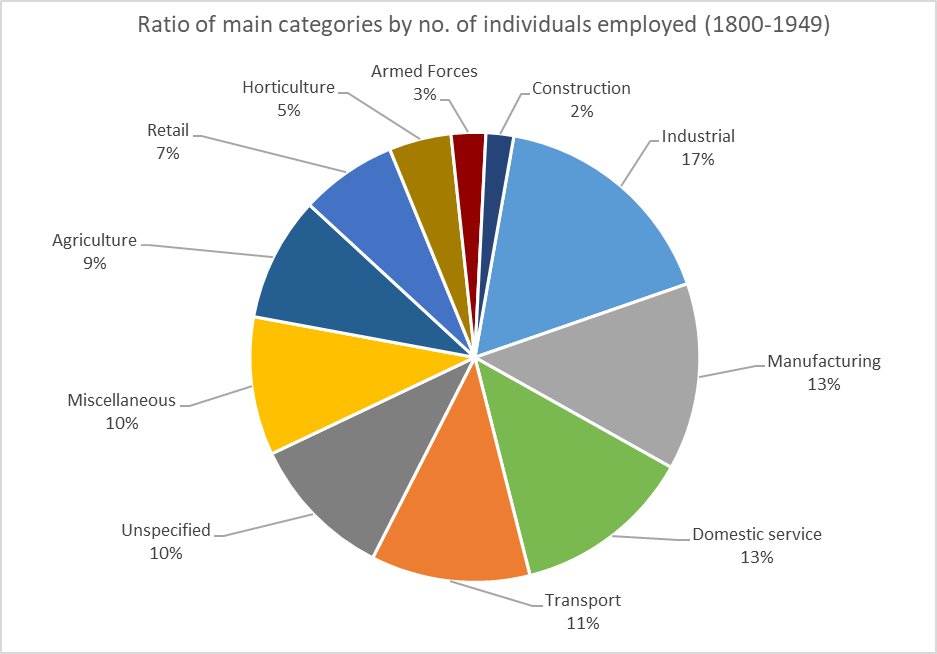
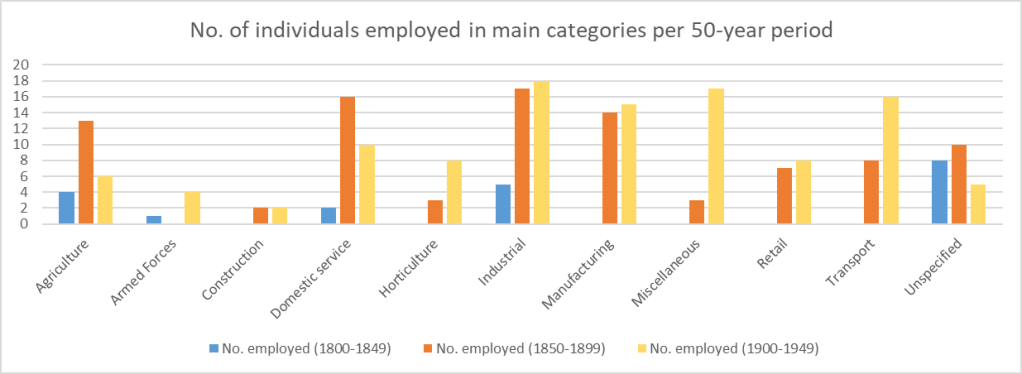
Additionally, employments have been listed in 50-year periods (1800-1849, 1850-1899 & 1900-1949) to look at broad changes in types of employment across the years. [It should be noted that the number of records of individuals researched are not equal across periods so comparisons should be seen as a general indication only].
If the 50-year periods are compared there is a noticeable drop in the number of people employed in agriculture and domestic service between 1850-1899 & 1900-1949; while between those two periods there is a large increase in those employed in the transport category (mainly on the railways). These changes, although based on a relatively small number of individuals, are probably a reflection of change generally within society during this period. [See fig 2].
Individual categories of employment should be the subjects of more detailed articles in the future.
| Broad job category | Industrial | Miscellaneous | Transport |
| Individual job title | Miner | Window cleaner | Railway platelayer |
| Dyer | Slaughterhouse caretaker | Railway porter | |
| Puddler – ironworks | Retired Jockey & trainer | Railway surveyors chainman | |
| Chemical works labourer | Clerk | Railway goods guard | |
| Iron works – Labourer | Slaughterhouse superindentant | Carrier | |
| Forgeman | Clerkess | Railway refreshments – Dept. Supervisor | |
| Coal Miner | Fisherman | Carter | |
| Iron worker | House painter | Railway Clerk | |
| Mine calciner | Railway refreshments – Waitress | ||
| Collier | Railway labourer | ||
| Bricksetter | Railway guard | ||
| Salt boiler | |||
| Chemical labourer | |||
| Salt maker | |||
| Engine fitter | |||
| Steel works labourer | |||
| Broad job category | Manufacturing | Retail | Domestic Service |
| Individual job title | Confectionary warehouseman | Milliner | Domestic servant |
| Velvet cutter | Ironmonger’s assistant | Groom | |
| Weaver | Baker | Coachman | |
| Tobacco spinner | Charwoman | ||
| Woolen Weaver | General domestic servant | ||
| Power loom weaver | Horse breaker | ||
| Shipwright | Housekeeper | ||
| Shipwright – Apprentice | Gamekeeper | ||
| Housemaid |
 Dorman & Wakeley Family History